Advantages of CNC Turning in Precision Machining
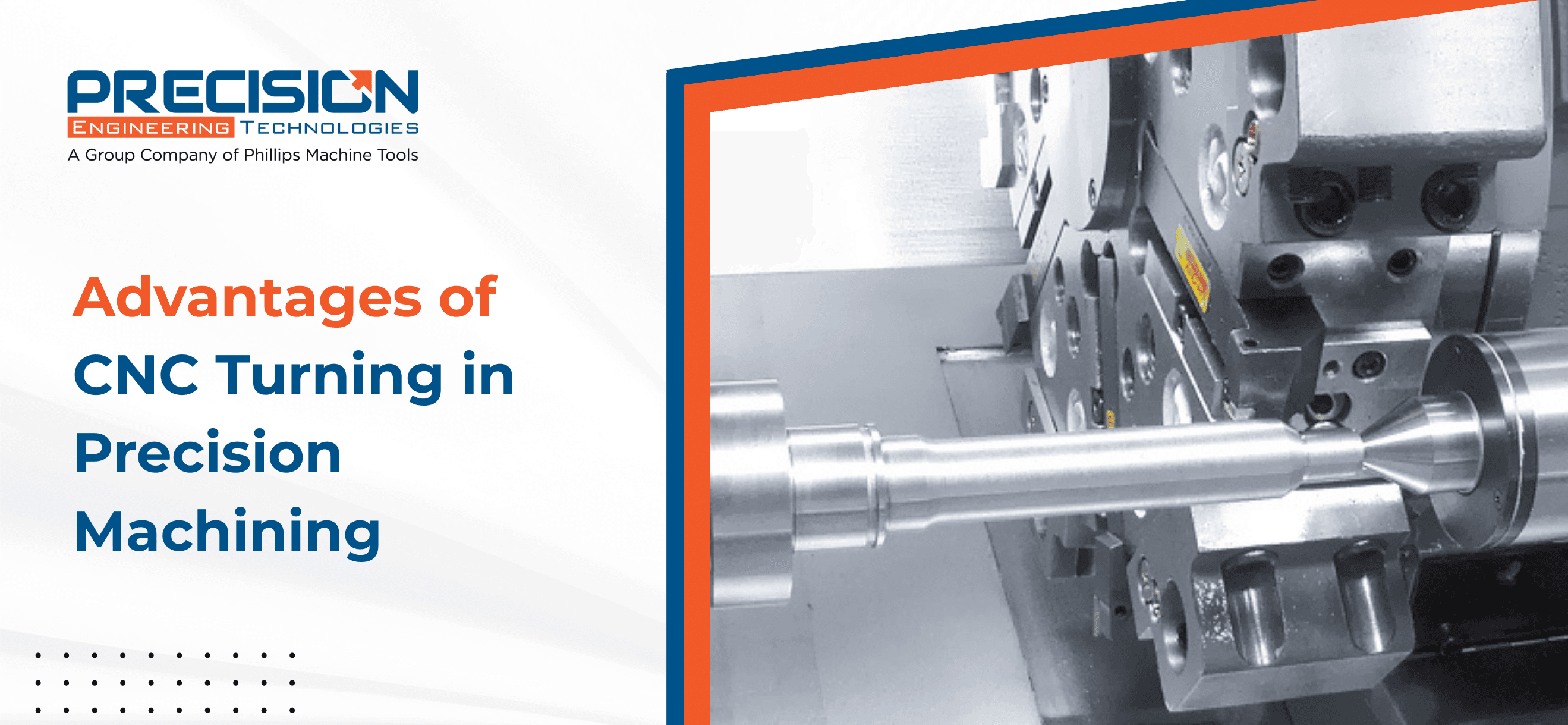
Table of Content:
In modern precision manufacturing, the demand for dimensional accuracy, tight tolerances, and part-to-part consistency is higher than ever, especially in industries like commercial aerospace, medical devices, and high-performance automotive. At the heart of these operations is CNC turning manufacturing, a technology that has evolved well beyond basic lathe automation.
Today’s CNC turning centers integrate multi-axis control, adaptive tooling, and real-time monitoring to enable the efficient production of complex components with minimal rework. This blog explores the advantages of CNC turning, its impact on precision production, and how new innovations are reshaping its capabilities.
What is CNC Turning?
CNC turning is a subtractive machining process where a cutting tool removes material from a rotating workpiece to shape it into the desired geometry. Governed by G-code programming, the cutting paths are executed with high precision, making the process ideal for cylindrical, conical and symmetric parts.
CNC turning operations can be carried out on single-spindle, dual-spindle or multi-axis turning centres. It is a core function in automated manufacturing cells and often integrates seamlessly with robotic material handling and quality control systems.
Importance of CNC Turning in Precision Machining
Precision machining demands the ability to meet tight tolerances consistently, especially when manufacturing parts with functional or safety-critical roles. CNC turning manufacturing enables:
- Repeatable part production with micron-level tolerances
- Scalability across prototyping and high-volume production
- Reduced human error via automation
- Versatility in design execution, including tight surface finishes and complex internal features
Whether you are building titanium-grade surgical instruments or performance automotive drivetrain components, CNC turning ensures parts perform as engineered.
Key Advantages of CNC Turning Manufacturing
Unmatched Accuracy
Modern CNC turning centers can routinely achieve tolerances within ±0.0025 mm, powered by CAD/CAM integration and in-machine feedback loops. This is essential for:
- Medical devices where even slight dimensional deviations can impact functionality
- Commercial aerospace engine housings and fasteners that demand zero error margins
Superior Repeatability
Once the setup and calibration are complete, the same program can produce thousands of identical parts without deviation. This ensures:
- Streamlined inspection protocols
- Reduced quality control intervention
- Minimized rework
Scalability from Prototype to Production
From single-piece prototyping to multi-thousand-part production, CNC turning supports:
- Fast design iteration
- Seamless transition from R&D to manufacturing scale
- Just-in-time production models
Excellent Surface Finishes
With optimized feed rates, tool geometries and coolant delivery, CNC turning can deliver finishes that eliminate the need for post-processing in many cases, supporting tighter production timelines.
Process Stability and Reduced Human Error
Once programmed, CNC turning systems reduce reliance on manual adjustments. Fewer operator variables mean:
- Lower scrap rates
- Improved machine uptime
- Increased safety
Cost Optimization Over Time
While capital investment is significant, CNC turning yields long-term savings through:
- Reduced labor costs
- Higher throughput
- Minimal raw material waste
Flexible Material Handling
CNC turning machines can work with a diverse range of metals and polymers, including:
- Aluminum, brass and copper
- Hardened steels and tool steels
- Inconel, titanium and other exotic alloys
Improved Production Efficiency in CNC Turning
CNC turning manufacturing improves production throughput through several key efficiencies:
- Shorter Cycle Times: High-speed spindles, multi-station turrets and tool changers reduce idle time.
- Continuous Operation: With minimal supervision, machines can operate 24/7 for overnight or lights-out production.
- Rapid Job Switching: Modular fixtures and programmable setups reduce changeover from hours to minutes, supporting flexible manufacturing lines.
Applications of CNC Turning Manufacturing in Precision Machining
The advantages of CNC turning are harnessed across industries, including:
- Commercial Aerospace: Components such as turbine shafts, fasteners, bushings and landing gear elements.
- Automotive: Drive shafts, pistons, brake system components and wheel hubs.
- Medical: Titanium bone screws, dental implants and surgical housings.
- Electronics: Connectors, sensor housings and thermal management hardware.
- Energy: Pressure vessel fittings, rotor shafts and heat-resistant couplings.
Technological Advancements in CNC Turning
Recent developments have further expanded the capabilities of CNC turning manufacturing:
- Multi-Axis Turning Centers: Capable of 4, 5 or even 9-axis operation to machine complex parts in a single setup.
- Live Tooling Integration: Allows secondary operations such as milling, tapping and drilling on the same machine.
- IoT & Smart Monitoring: Real-time spindle diagnostics, vibration analysis and thermal feedback enable predictive maintenance.
- Digital Twin Simulation: Tool paths can be simulated and optimized before a single cut is made, reducing setup errors and material waste.
Conclusion
The advantages of CNC turning lie in its unmatched combination of speed, precision and adaptability. From precision medical parts to complex commercial aerospace assemblies, CNC turning solutions delivers scalable solutions for every stage of manufacturing.
At PETECH, we help clients tap into this capability through industry-leading automation, machining solutions and consultation services. Whether you are looking to upgrade your operations or outsource high-precision turning, we have the systems and experience to drive your success.